Perplexity AI vs Google: Which Is Better in 2026?
Perplexity AI vs Google is no longer simply a comparison between an AI search engine and traditional web search. In 2026, both platforms use artificial intelligence to help users find, understand, and explore information online.
Google has expanded its search experience with AI Overviews and AI Mode, which can provide AI-generated answers, follow-up conversations, and deeper searches across related subtopics. Perplexity, meanwhile, is built around answering questions by searching multiple sources, synthesizing the information, and providing citations that let users check the underlying sources.
So which one should you use?
The answer depends largely on what you are trying to accomplish.
If you need to discover websites, compare products, find local businesses, explore current information, or browse different search results, Google remains a powerful option. If you want a more direct research-style answer with sources gathered and summarized for you, Perplexity offers a different workflow.
This guide compares Perplexity and Google in 2026 across research, source verification, current events, local searches, shopping, SEO research, AI-powered answers, and everyday information searches.
Rather than simply declaring a winner, we’ll look at how each platform works, where their approaches differ, and when one may be more useful than the other.
Table of Contents
Google Search in 2026: More Than Traditional Search
One important change makes an old-style Perplexity-versus-Google comparison incomplete: Google Search itself has become increasingly AI-powered.
Google’s current Search experience includes AI Overviews and AI Mode, allowing users to ask more conversational questions, continue with follow-up questions, and explore supporting links and websites. Google has also expanded multimodal Search and introduced additional AI-powered capabilities in 2026.
This means Google is no longer simply a choice between a traditional list of links and an AI answer. Depending on the query, users can move between AI-generated answers, traditional results, websites, images, videos, shopping, maps, and other parts of Google’s search ecosystem.
For this reason, the real comparison in 2026 is Perplexity’s AI-first research experience versus Google’s broader AI-powered search ecosystem.
Perplexity vs Google by Search Intent
What Makes Perplexity Different?
Direct Answers With Citations
Perplexity’s core experience is designed to answer questions directly while showing source links. This makes it especially useful when the goal is to understand a topic and verify where the information came from.
Multi-Source Research
For more complex questions, Perplexity can search across multiple sources and synthesize the information into a single response instead of requiring the user to manually compare many individual pages.
Follow-Up Research
Perplexity also supports conversational follow-up questions, allowing users to refine a research task without starting over from a completely separate search.
Deep Research
For more demanding research tasks, Perplexity offers Deep Research capabilities that perform multiple searches across many sources before producing a longer report. The exact availability and limits depend on the plan and current product configuration.
Perplexity vs Google for Research
Winner: Perplexity for research-heavy workflows. Perplexity is built around researching the web, synthesizing information, and showing source links. This can make it more convenient when you want to understand a topic rather than simply locate a webpage.
Perplexity vs Google for Everyday Questions
Winner: It depends. Perplexity is useful when you want a direct synthesized answer. Google is often better when your question could lead to a website, map result, product, video, image, or another specialized search experience.
Perplexity vs Google for Finding Websites
Winner: Google. If the goal is to locate a particular website, brand, page, or broad set of search results, Google’s traditional Search experience remains particularly useful.
Perplexity vs Google for Local Search
Winner: Google. Local searches benefit from Google’s Maps and local search ecosystem, especially when you need businesses, directions, opening information, or nearby places.
Perplexity vs Google for Shopping
Winner: Google for product discovery. Google can combine web search with its broader shopping experience, making it a strong option when comparing products, sellers, prices, and availability.
Perplexity vs Google for Current Information
Winner: Both can be useful. Perplexity emphasizes its live web index and cited answers, while Google Search combines fresh web information with its AI-powered Search experiences. The better option depends on whether you want a synthesized research answer or a broader search journey.
Perplexity vs Google for Complex Questions
Winner: Perplexity for research-oriented questions. Perplexity’s research workflow is particularly useful when a question requires several searches, source comparison, and synthesis.
Quick Answer: Perplexity vs Google in 2026
Perplexity is usually better for research-heavy questions, synthesized answers, citations, and comparing information from multiple sources. Google remains the stronger choice for finding specific websites, local businesses, shopping results, maps, images, videos, and exploring the wider web.
However, the difference is smaller than it used to be. Google Search now includes AI Overviews and AI Mode, with conversational follow-up questions and links that help users continue exploring the web.
So which one is better? There is no single winner. Choose Perplexity when you want an AI research assistant; choose Google when you want the broader search ecosystem and direct access to the web.
Perplexity vs Google: Which One Is Better for You?
The best choice depends on what you are trying to accomplish. Instead of asking which service is universally better, compare them by search intent.
| Search task | Better choice | Why |
|---|---|---|
| Complex research | Perplexity | It is designed to synthesize information from multiple web sources and show citations. |
| Finding a specific website | Google remains built around broad web discovery and navigation. | |
| Local businesses and places | Maps and local search make Google especially useful for location-based searches. | |
| Shopping research | Google combines Search with its broader shopping ecosystem. | |
| Research with cited answers | Perplexity | Perplexity places citations and source links directly alongside its answers. |
| Conversational follow-up questions | Both | Both now support conversational interactions, although the surrounding search experience differs. |
| Broad web exploration | Google provides access to a wide range of traditional and AI-powered search experiences. | |
| Fast synthesized answers | Perplexity | Its core experience is built around answering questions with synthesized web information. |
Perplexity AI vs Google: What’s Actually Different?
At first glance, Perplexity and Google may seem to do the same thing: you enter a question and receive information from the web. However, the two platforms approach search in different ways.
Google Search is designed around discovering information across the web. Depending on the query and the features available, Google can show traditional search results, AI Overviews, and AI Mode responses. AI Mode can also handle follow-up questions and break complex searches into related subtopics to gather information from multiple searches.
Perplexity takes a more answer-focused approach. It searches for relevant information, combines information from multiple sources, and presents a synthesized response with citations that allow you to inspect the sources behind the answer.
The difference becomes clearer when you consider the typical workflow:
| Feature | Perplexity | |
|---|---|---|
| Traditional web results | Yes | Yes |
| AI-generated answers | Yes | Yes |
| Follow-up questions | Yes, including AI Mode | Yes |
| Source citations | Available, depending on the result | Central to the answer experience |
| Direct source discovery | Strong | Strong |
| Research-style synthesis | Available through AI features | Core part of the experience |
| Complex multi-step research | AI Mode can break searches into related subtopics | Designed for research-oriented queries |
Neither approach completely replaces the other.
Google can be useful when you want to explore the web, compare different sources, find specific websites, or search for local and commercial information. Perplexity can be useful when you want to start with a question and receive a synthesized answer with sources to investigate further.
The most important difference, therefore, is not simply whether the platform uses AI. It is how AI is integrated into the search process and how information is presented to the user.
1. What Is Perplexity AI and How Does It Work?
Perplexity is an AI-powered search and research platform that combines web search with AI-generated answers. Instead of requiring users to open and compare multiple search results before forming an answer, Perplexity can search for relevant information, synthesize findings from multiple sources, and present the result with citations.
Think of it as a research-oriented search workflow: you ask a question in natural language, Perplexity searches for relevant information, and the system organizes the findings into a readable response that you can investigate further through the cited sources.
Perplexity also supports follow-up questions, allowing you to continue exploring a topic within the same conversation rather than starting a completely new search each time.
The exact Perplexity experience depends on the plan and search mode you use. The current Standard (Free) plan provides practically unlimited basic searches, while advanced features such as Pro Search and Research have separate usage limits. Paid plans provide higher limits and access to additional models and research capabilities.
Because these limits can change, check Perplexity’s current plan details before choosing a subscription.
For more information about AI tools and how different AI platforms work, see our complete guide to AI tools.
The key idea is simple: Perplexity combines web search, AI synthesis, and source citations into a single research workflow.
2. The Core Difference: Search, Synthesis and Sources
The biggest difference between Google and Perplexity is not simply that one uses AI and the other does not. Both platforms now use AI to help users understand information. The more important difference is how they organize the search process and present the information they find.
Google’s approach
Google Search is primarily designed to help you discover information across the web. Depending on your query and the features available, you may see traditional search results, AI Overviews, or use AI Mode for a more conversational search experience.
AI Mode can handle follow-up questions and more complex searches by breaking a question into related subtopics and searching for information across multiple areas of the web.
Google’s current AI Mode documentation explains that AI Mode can handle follow-up questions, explore information from multiple web sources, and break complex questions into related subtopics before combining the results.
This gives Google a flexible workflow: you can start with a traditional search result, explore individual websites, use an AI-generated overview, or continue the conversation through AI Mode.
For example, if you search for a specific website, product, business, location, or piece of content, Google’s search ecosystem can provide direct links and specialized results alongside its AI features.
Perplexity AI’s approach
Perplexity is more strongly centered around an answer-first research workflow.
Instead of making the user navigate through several search results before building an answer, Perplexity can search for relevant information, synthesize findings from multiple sources, and present the result in a conversational response.
Citations are an important part of this experience. They allow you to move from the AI-generated answer back to the sources used to support the response.
This makes Perplexity particularly suited to questions where you want to start with a detailed explanation and then investigate the sources behind it.
Perplexity’s Pro Search documentation describes the feature as an advanced search workflow that conducts multiple web searches, synthesizes information from diverse sources, and provides direct citations to the underlying sources.
The practical difference
The two workflows can therefore look like this:
Google:
Search → explore results → compare sources → use AI features when useful → verify information
Perplexity:
Ask a question → search and synthesize information → review the answer → open citations → investigate further
These workflows can overlap, especially now that Google offers AI-powered search experiences. The distinction is mainly about where the synthesis happens and how the user interacts with the underlying sources.
For simple navigational searches, direct website searches, local information, shopping, or broad web exploration, Google’s different search surfaces can be especially useful.
For research questions where you want a synthesized explanation followed by supporting sources, Perplexity offers a more answer-focused workflow.
The two platforms can also be used together: use AI-assisted search to understand a topic quickly, then open the underlying sources and verify important information yourself.
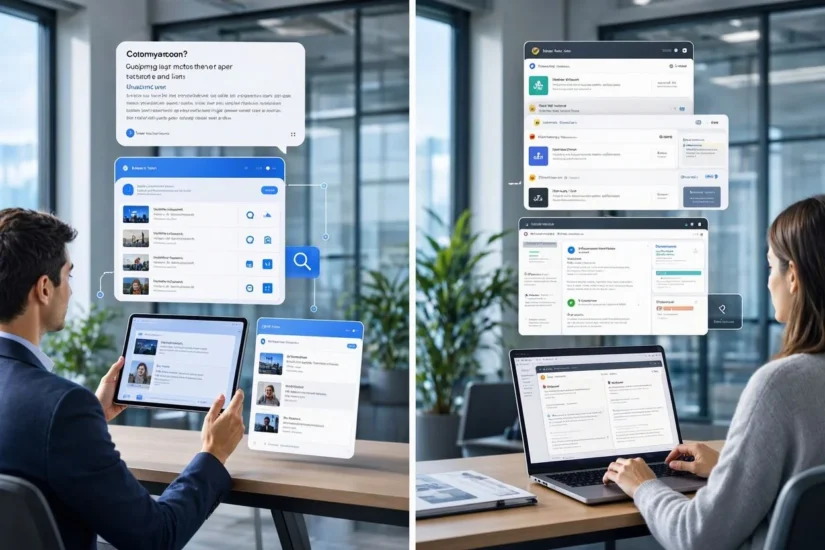
3. Perplexity vs Google for Research: How the Workflows Differ
Research is one of the areas where the differences between Perplexity and Google become particularly noticeable.
With a traditional Google search workflow, you may need to open several pages, compare information from different sources, and decide which sources are relevant before reaching your own conclusion. Google’s AI-powered features can reduce some of this work by summarizing information and helping you explore related questions, but the underlying web results remain an important part of the experience.
Perplexity approaches the same type of task from an answer-first perspective. It can search for relevant sources, synthesize information from them, and present the findings in a conversational response with citations.
A typical research workflow with Google
For a complex question, a Google-based workflow might look like this:
- Start with a broad search query.
- Review the search results and identify relevant sources.
- Open several pages to compare information.
- Refine the search when important information is missing.
- Use AI Overviews or AI Mode when they are available and useful.
- Check the original sources before relying on important claims.
This approach gives you a high degree of control over which websites and sources you investigate.
A typical research workflow with Perplexity
With Perplexity, the process can be more centralized:
- Ask the research question in natural language.
- Let Perplexity search for relevant information.
- Review the synthesized response.
- Open the citations that matter to your research.
- Ask follow-up questions when you need additional context.
- Check the original sources before relying on important claims.
This can reduce the amount of manual searching required to build an initial understanding of a topic.
Which workflow should you use?
There is no need to choose one platform for every research task.
Google can be useful when you want to control the discovery process, explore many websites, find a particular source, or investigate information that requires broader web exploration.
Perplexity can be useful when you want to start with a specific research question and quickly build a synthesized understanding of the topic with sources to investigate further.
For important research, a combined workflow can also be useful: use an AI-powered search experience to develop an initial understanding, then open and verify the underlying sources before using the information in a decision, publication, or professional project.
The important distinction is therefore not simply research speed. It is how much of the searching, synthesis, and source discovery is handled for you versus how much control you want over each step of the research process.

4. Perplexity AI vs Google: Accuracy and Source Quality
Finding information quickly is only useful if you can evaluate whether that information is reliable. For both Perplexity and Google, the quality of the final answer depends not only on the AI system or search engine, but also on the sources available for a particular query.
Citation transparency
One of Perplexity’s most visible features is its use of citations within AI-generated answers. These citations allow users to open the referenced sources and investigate where the information came from.
This can make source verification more straightforward, particularly when researching a topic that requires information from several websites.
However, a citation does not automatically mean that an AI-generated statement is completely correct. The cited page may contain outdated information, the AI may interpret the source incorrectly, or the citation may support only part of a broader statement.
For important claims, the safest approach is still to open the original source and check the relevant context.
Google’s source ecosystem
Google provides access to a very broad range of websites and specialized search experiences. Depending on the query, users can discover news sources, official websites, academic resources, product pages, local businesses, forums, videos, and other types of content.
Google’s AI-powered search features can also summarize information from multiple sources, but users can continue to explore the underlying search results and visit individual websites directly.
This gives Google a broad search environment where users can discover and compare different websites, source types, and specialized search results themselves.
Source breadth vs. synthesized answers
The difference can be summarized this way:
| Research need | Perplexity | |
|---|---|---|
| Discover many websites | Strong | Strong |
| Read a synthesized answer | Available through AI features | Core part of the experience |
| Follow source citations | Depends on the search result or AI feature | Central to the answer experience |
| Investigate the original source | Yes | Yes |
| Compare different types of sources | Strong | Strong |
| Verify important claims | Open the underlying sources | Open the cited sources |
Neither platform guarantees that every answer will be correct.
For research, the most reliable workflow is to treat AI-generated answers as a starting point, then verify important claims against authoritative or primary sources.
Current information and breaking news
Both platforms can provide access to current information, but the availability and presentation of recent information can vary depending on the query, sources, search mode, and platform features.
For rapidly changing topics, it is particularly important to check the publication date of the sources rather than assuming that an AI-generated answer reflects the latest development.
This matters for subjects such as breaking news, product availability, prices, regulations, software updates, and other information that can change quickly.
The practical takeaway
Perplexity’s citation-focused answer format can make it convenient to move from a synthesized explanation to the sources behind it.
Google’s broader search ecosystem gives users more flexibility to discover different websites, source types, and specialized results.
For both platforms, the presence of AI does not eliminate the need for source verification. When accuracy matters, use the AI-generated response to accelerate research, then check the underlying sources before relying on the information.
5. Perplexity vs Google for Different Search Tasks
The differences between Perplexity and Google become easier to understand when you look at specific types of searches.
Instead of asking which platform is universally better, it is more useful to consider how each search experience fits a particular task.
Navigational searches
If you already know where you want to go, Google can provide a direct path to a website, service, or specific page.
For example:
- Gmail login
- Amazon
- Canva
- a company’s official website
- a specific product page
Perplexity can answer these queries too, but its answer-first format may add information that you do not need when your goal is simply to reach a particular website.
Practical difference: Google is often convenient when the objective is to locate a specific destination quickly, while Perplexity is more oriented toward answering the question itself.
Local searches
Local searches are another area where the two platforms can provide different experiences.
Queries such as:
- “best pizza near me”
- “dentist open Saturday”
- “parking near Wembley Stadium”
- “coffee shops in Madrid”
can involve information such as locations, opening hours, reviews, directions, and business details.
Google’s integration with Maps and its broader local search ecosystem makes it particularly useful for this type of search.
Perplexity can still help you research local options or summarize information about businesses, but users should verify important details such as opening hours, availability, and location directly with the business.
Practical difference: Google provides a more integrated local-search workflow, while Perplexity can be useful for researching and comparing information about local options.
Image and video searches
Google provides dedicated search experiences for visual content, including Google Images and connections to video results such as YouTube.
This can be useful when your goal is to:
- find a specific image;
- discover visual references;
- locate a tutorial;
- search for a particular video;
- explore visual content across the web.
Perplexity can incorporate visual information into some search experiences, but it is primarily centered around answering questions and synthesizing information.
Practical difference: Google is particularly useful when the search itself is focused on discovering visual or video content.
Shopping and product searches
Shopping searches require more than simply finding information about a product.
Users may want to compare:
- prices;
- retailers;
- product specifications;
- reviews;
- availability;
- different versions of the same product.
Google’s shopping and search ecosystem can provide product-oriented results and links to retailers.
Perplexity can be useful for researching products, comparing specifications, and summarizing information from different sources, but product information such as price and availability can change quickly.
For a purchase decision, it is therefore important to verify current information directly on the retailer or manufacturer’s website.
Practical difference: Google can be useful for discovering products and shopping-related results, while Perplexity can be useful for researching and comparing product information.
SEO and marketing research
Both platforms can also be useful for SEO and marketing research, but they serve different purposes.
Google provides access to the actual search results environment, including search queries, websites, related searches, and other search features that marketers can analyze.
For broader AI-assisted marketing workflows, you can also explore our guide to AI tools for social media marketing.
Perplexity can be useful during the research phase when you want to investigate a topic, identify sources, compare information, or quickly build background knowledge before developing content.
For SEO professionals, this means the two platforms can complement each other rather than serving exactly the same purpose.
Practical difference: Google is useful for examining the search ecosystem itself, while Perplexity can accelerate research and information gathering before content or marketing work begins.
The key takeaway
There is no single search workflow that fits every query.
A useful approach is to choose the platform based on the task:

| Search task | Perplexity | |
|---|---|---|
| Find a specific website | Direct search experience | Can provide the destination with additional context |
| Local search | Maps and local search ecosystem | Research and comparison |
| Image and video discovery | Dedicated visual and video search | AI-assisted information discovery |
| Product research | Shopping and product-oriented results | Product research and comparison |
| Complex research | Search results plus AI features | Answer-focused research and synthesis |
| SEO research | Direct access to search results | Topic and source research |
The most useful workflow may also involve using both platforms at different stages of the same research process.
6. Perplexity vs Google: Comparison Table
The following table summarizes the main differences discussed in this guide.
| Category | Perplexity | |
|---|---|---|
| Traditional web search | Extensive search results and website discovery | Web search combined with an AI-generated answer |
| AI-generated answers | Available through AI-powered search features | Central part of the search experience |
| Follow-up questions | Available, including through AI Mode | Available through conversational search |
| Source discovery | Broad access to websites and specialized search results | Sources are presented alongside synthesized answers |
| Source citations | Depends on the search feature and result | Citations are a central part of the answer experience |
| Complex research | Search results combined with AI-assisted features | Research-focused, answer-first workflow |
| Local search | Strong integration with local search and Maps | Can research and summarize local information |
| Shopping | Product and shopping-oriented search features | Useful for product research and comparisons |
| Images and video | Dedicated image and video search experiences | Primarily focused on AI-generated research answers |
| SEO research | Direct access to the Google search environment | Useful for topic and source research |
| Information verification | Users can open and compare original websites | Users can follow citations to the referenced sources |
What this comparison means
The table does not identify a universal winner because the two platforms are designed around different search workflows.
Google provides a broad search ecosystem for discovering websites, local information, products, images, videos, and other types of content, while also offering AI-powered search experiences.
Perplexity places more emphasis on conversational research, synthesized answers, and citations that connect the response to its sources.
For many users, the most practical approach is not to choose one platform for every search. Instead, use the platform that matches the task and verify important information against the original sources.
If you are also comparing AI assistants beyond search, see our guide to ChatGPT vs Claude vs Gemini for a broader comparison of today’s major AI platforms.
7. Practical Tips for Using Perplexity and Google
Instead of treating Perplexity and Google as competing replacements for each other, you can use them at different stages of the same research workflow.
Tip 1 — Start with the tool that matches your goal
Use Google when your goal is to find a specific website, explore search results, locate a business, discover products, or browse visual and video content.
Use Perplexity when your starting point is a question that requires explanation, comparison, or synthesis from multiple sources.
The distinction is not absolute, but it can help you decide where to begin.
Tip 2 — Always verify important information
AI-generated answers can contain mistakes, incomplete context, or information that has become outdated.
When a claim is important, open the cited or underlying source and check the original information.
This is particularly important for:
- financial information;
- legal or regulatory information;
- medical information;
- statistics;
- current prices;
- product availability;
- breaking news;
- information you plan to publish.
A citation is a useful starting point for verification, not a guarantee that the entire AI-generated answer is correct.
Tip 3 — Use follow-up questions to refine research
Perplexity’s conversational interface allows you to continue exploring a topic after the initial answer.
Instead of starting a completely new search, you can ask follow-up questions such as:
- “Can you explain the second point in more detail?”
- “What are the main counterarguments?”
- “Which sources support this conclusion?”
- “Can you compare these two options?”
- “What information is missing from this answer?”
This can make a research session more structured and help you identify areas that require additional verification.
Tip 4 — Use focused searches for specific research needs
When researching a particular subject, make the question as specific as possible.
Instead of:
“Tell me about AI search.”
Try:
“How does AI Mode differ from traditional Google Search in the way it handles complex research queries?”
A more precise question gives the search system clearer context and makes it easier to evaluate whether the resulting sources actually answer your question.
Tip 5 — Combine Perplexity and Google
You do not have to choose one platform for the entire research process.
For example:
Step 1: Use Perplexity to build an initial understanding of a complex topic.
Step 2: Open the citations and identify the most useful original sources.
Step 3: Use Google to search for additional sources, official pages, specific websites, or information that may not have appeared in the initial answer.
Step 4: Compare the sources and verify important claims.
Step 5: Use the verified information for your final research, content, or decision.
This combined workflow takes advantage of the different ways both platforms can help with information discovery and research.
8. Frequently Asked Questions
Is Perplexity AI free to use in 2026?
Yes. Perplexity offers a free plan that provides access to basic search and AI-powered answers. More advanced features, higher usage limits, and additional models are available through paid plans.
The exact limits can change over time, so users should check Perplexity’s current plan details before choosing a subscription.
Is Perplexity AI more accurate than Google?
There is no simple answer. Accuracy depends on the query, the sources available, and how the information is presented.
Perplexity can make source verification convenient because its answers commonly include citations that users can open and inspect. Google provides access to a much broader search ecosystem, allowing users to compare websites and sources directly.
For important information, you should verify the underlying sources rather than assuming that either platform is always correct.
Can Perplexity AI replace Google?
For some research tasks, Perplexity can reduce the need to browse multiple search results manually. However, it does not replace every function of Google Search.
Google remains useful for discovering specific websites, local businesses, products, images, videos, and other specialized search results. Perplexity is particularly useful when you want to begin with a question and receive a synthesized answer with sources.
For many users, the two platforms can be complementary rather than mutually exclusive.
Does Perplexity provide real-time information?
Perplexity can search the web and use current online information when answering questions. However, the availability and freshness of information can vary depending on the query, sources, and search mode.
For breaking news, rapidly changing prices, product availability, regulations, or other time-sensitive information, always check the date of the sources and verify important details with authoritative sources.
Is Perplexity AI safe and private to use?
Privacy depends on the features, settings, and plan you use, as well as the type of information you provide to the service.
As with any online AI or search platform, avoid entering sensitive personal information unless you understand how the service handles that data. Review the provider’s current privacy policy and account settings before using the platform for sensitive research.
Which is better for research: Perplexity or Google?
The answer depends on the research workflow you prefer.
Perplexity is designed around an answer-first experience that combines web search, synthesis, and citations. Google provides a broader search environment where you can discover and compare many different types of sources.
For complex research, a combined workflow can also be useful: start with a question, inspect the sources provided, search Google for additional primary or authoritative sources, and compare the information before reaching a conclusion.
Should I use Perplexity or Google for everyday searches?
Use the platform that matches the task.
Google can be particularly useful when you want to find a specific website, business, product, image, video, or local result. Perplexity can be useful when you want an explanation, comparison, summary, or research-oriented answer with sources.
Neither platform needs to be your only search tool.
9. Conclusion
Is Perplexity AI better than Google in 2026? There is no single answer that applies to every search.
The main difference is the way the two platforms approach information discovery.
Google provides a broad search ecosystem where users can discover websites, businesses, products, images, videos, news, and other types of content. Its AI-powered search features also make it possible to ask more complex questions and continue exploring a topic conversationally.
Perplexity takes a more answer-focused approach. It combines web search with AI-generated responses, source citations, and conversational follow-up questions. This can be useful when your goal is to build an initial understanding of a topic without manually opening and comparing as many sources.
For research, the choice often comes down to how much control you want over the discovery process versus how much synthesis you want the search system to perform for you.
You also do not have to choose only one. A practical workflow can involve using Perplexity to explore and structure a question, opening its citations to identify useful sources, and then using Google to discover additional websites, official pages, or specialized search results.
The most important habit is the same with both platforms: verify important information against the original or authoritative sources before relying on it.
So rather than asking whether Perplexity or Google is universally better, ask a more useful question:
Which search workflow fits the task I am trying to accomplish?
That is the real difference between Perplexity and Google in 2026.
Perplexity or Google: Which Should You Use?
Use Perplexity when your main goal is research. It is particularly useful when you want a synthesized answer, source citations, multi-source research, and conversational follow-ups.
Use Google when your main goal is finding and navigating the web. It remains especially strong for websites, local search, shopping, maps, images, videos, and the broader Google ecosystem.
Use both when accuracy and exploration matter. Perplexity can help you understand and organize a topic, while Google can help you locate original websites, specialized results, and additional sources.
The best choice in 2026 is therefore not about replacing one with the other. It is about matching the search tool to the task.
Perplexity vs Google FAQ
Is Perplexity better than Google?
Perplexity can be better for research-oriented questions because it focuses on synthesized answers with source citations. Google remains better for many navigation, local, shopping, media, and broad web-search tasks. The better choice depends on the query.
Is Perplexity more accurate than Google?
Neither should be treated as automatically accurate. Both can provide incorrect or incomplete information. Perplexity makes source verification convenient through citations, while Google gives users access to a broader range of webpages and search results.
What is the difference between Perplexity and Google?
Perplexity is primarily an AI-first answer and research experience. Google is a broader search ecosystem that combines traditional Search with AI-powered experiences such as AI Overviews and AI Mode.
Should I use Perplexity or Google for research?
Perplexity is often the more convenient starting point for research because it synthesizes multiple sources into an answer and provides citations. Google can then be useful for opening original pages, checking additional sources, and exploring the wider web.
Can Perplexity replace Google?
Not completely. Perplexity can replace a traditional search engine for some research tasks, but Google remains particularly useful for navigation, local search, shopping, maps, images, videos, and many other specialized search experiences.
Is Google better than Perplexity for local search?
Generally, yes. Google’s integration with Maps and local search makes it a stronger choice when you need nearby businesses, locations, directions, or local information.